

Shocking Discovery Near Neptune: The solar system has surprised us again — and this time, it’s something big. Astronomers at Princeton University have announced a stunning new finding: a hidden “inner core” near Neptune, a mysterious and previously unseen structure deep in the Kuiper Belt. Before you imagine glowing lava or magnetic fields, let’s clear something up — this “inner core” isn’t inside a planet. Instead, it’s a cluster of icy worlds, quietly orbiting the Sun billions of miles away. This new region, called the “inner kernel”, may hold the keys to understanding how the solar system formed more than 4 billion years ago.
Shocking Discovery Near Neptune
The discovery of a hidden “inner core” near Neptune isn’t just a new chapter in astronomy — it’s a reminder that the universe is full of surprises waiting to be uncovered. These icy remnants orbiting four billion miles away may hold the story of how everything — from the Sun to Earth — first took shape. Thanks to modern algorithms, powerful observatories, and human curiosity, we’re now closer than ever to decoding that story. The outer solar system, once thought empty and quiet, is turning out to be alive with secrets — and this “inner core” is one of its most captivating yet.
| Topic | Details |
|---|---|
| Discovery | Hidden “inner core” (also known as “inner kernel”) near Neptune |
| Researchers | Princeton University Astronomers (Official Source) |
| Distance from Sun | Around 43 Astronomical Units (AU), or ~4 billion miles |
| What It Is | A cluster of stable Kuiper Belt Objects (KBOs) with circular orbits |
| Age Estimate | Over 4 billion years old — possibly primordial |
| Scientific Importance | Offers insight into Neptune’s migration and solar system formation |
| Next Step | To be confirmed by Vera C. Rubin Observatory’s LSST project |
| Related Fields | Data Science, Astronomy, Planetary Physics |
| Eccentricity (Orbit Shape) | 0.01–0.06 — nearly perfectly circular |
The Kuiper Belt: The Solar System’s Mysterious Frontier
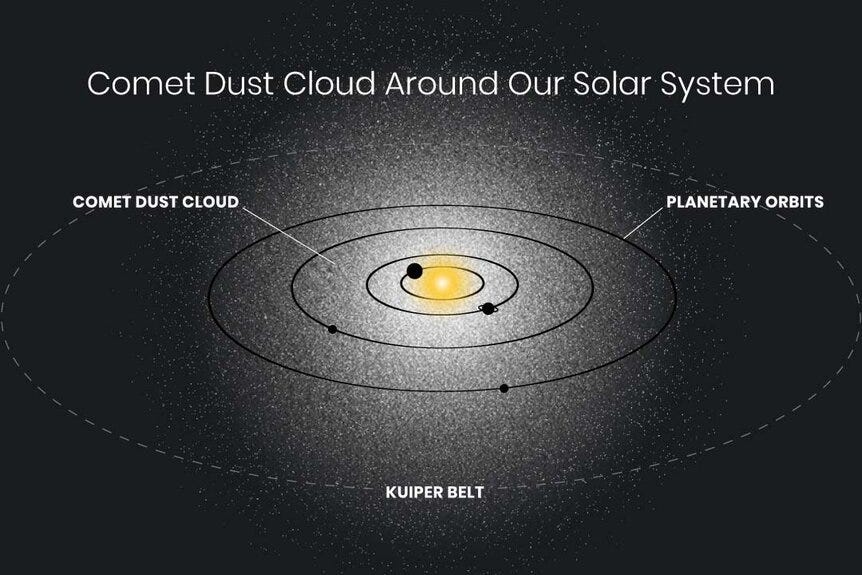
Far beyond the bright planets lies the Kuiper Belt, a region filled with icy remnants of the early solar system. It stretches from 30 AU to 50 AU beyond the Sun — a cold, dim frontier where sunlight barely reaches.
If the inner planets are the “downtown” of our solar system, the Kuiper Belt is its quiet outskirts — home to dwarf planets like Pluto, comets, and frozen debris left over from planetary construction. Scientists have long studied this zone to understand how the Sun and planets formed billions of years ago.
Until now, astronomers believed they had a pretty good map of this region. But the new Princeton findings show there’s a hidden structure inside this belt, suggesting our solar system might be far more complex than we thought.
How the Shocking Discovery Near Neptune Was Made?
This discovery didn’t come from new spacecraft or telescopes — it came from data.
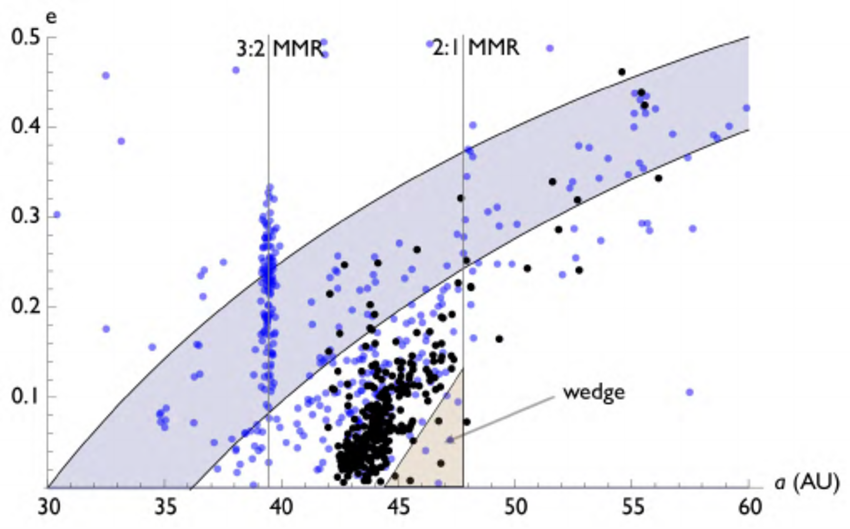
Researchers at Princeton analyzed a database of over 1,650 trans-Neptunian objects (TNOs) — small, icy bodies orbiting beyond Neptune. These objects are faint and distant, but their orbital paths hold clues to how the outer solar system evolved.
To find patterns in the chaos, scientists used a sophisticated clustering algorithm known as DBSCAN (Density-Based Spatial Clustering of Applications with Noise). This tool groups objects based on how closely their orbital properties match.
In doing so, the team confirmed a previously known group of objects called the “kernel” at 44 AU — but then noticed something even more intriguing: another distinct, tightly bound cluster closer to the Sun at about 43 AU.
This new grouping, now dubbed the “inner kernel” or “inner core,” had incredibly circular and stable orbits — unlike most objects in the outer solar system, which tend to wobble or tilt due to gravitational tugs from planets.
Why the “Inner Core” Is So Special?
Most objects beyond Neptune have eccentric (elongated) orbits because they’ve been influenced by Neptune’s strong gravity. But these newly identified bodies are different — their eccentricity is extremely low (0.01–0.06), meaning their orbits are almost perfect circles.
That stability hints at something profound: these objects may have remained undisturbed for more than 4 billion years, since the dawn of the solar system. They might be the oldest, most pristine survivors of the Sun’s creation — untouched fossils of the early cosmos.
Astronomers believe that by studying these ancient bodies, they can reconstruct what the solar system looked like before the planets settled into their current orbits.
A Quick Look Back: Neptune’s History of Surprises
Neptune has always been a planet of mystery. It was the first planet discovered using math, not observation. In 1846, astronomers noticed Uranus wasn’t moving as expected and predicted another unseen planet was pulling on it. When telescopes turned to the predicted spot — there Neptune was, almost exactly where mathematics said it would be.
Now, nearly two centuries later, math and data are again revealing Neptune’s hidden influence — this time not on another planet, but on an entire belt of icy worlds.
This new “inner core” may represent frozen evidence of Neptune’s ancient migration. Billions of years ago, Neptune may have drifted outward, dragging smaller objects with it or leaving them behind in circular paths. These icy bodies could be the footprints of that cosmic journey.
The Science Behind Shocking Discovery Near Neptune: Competing Theories
Scientists currently have two main theories about how this hidden core formed:
1. Primordial Origin Theory
According to this idea, the inner core’s objects have never moved. They formed right where they are, billions of years ago, and survived every gravitational disruption since then. This makes them direct witnesses to the solar system’s formation.
2. Neptune’s Migration Theory
Another possibility is that these objects were once scattered by Neptune when it moved outward. As Neptune “jumped” between positions due to gravitational interactions with other planets, it left behind stable groups of icy bodies. The inner core and outer kernel could be relics of those jumps — like ripples left in a pond after a stone drops.
Both ideas have supporters, and future observations will determine which one best fits the data.
What Makes This a “Shocking” Discovery?
This isn’t just a small addition to our cosmic map — it’s a potential paradigm shift.
Until now, astronomers assumed the Kuiper Belt’s structure was relatively uniform. But the discovery of a second “core” shows the outer solar system is layered and structured — more like a cake than a flat ring.
It means the forces that shaped our solar system were more complex than previously thought. If the “inner kernel” truly exists as a distinct population, it could force scientists to rewrite parts of our models for planetary evolution.
Confirming the Discovery: The Role of the Vera C. Rubin Observatory
The next step is confirmation — and that’s where the Vera C. Rubin Observatory comes in. Located in Chile, this state-of-the-art telescope will begin the Legacy Survey of Space and Time (LSST) soon, mapping the entire southern sky every few nights.
With its 3.2-gigapixel camera, the Rubin Observatory will spot even the faintest Kuiper Belt objects, measuring their positions and orbits with precision never before possible.
By analyzing thousands of new detections, scientists will confirm whether the inner kernel is truly a distinct group or simply part of a larger distribution. If confirmed, this will be one of the most significant outer solar system discoveries in decades.
Why This Matters Beyond Astronomy?
This discovery doesn’t just fascinate astronomers — it has lessons for anyone working in science, data, or technology.
- For data scientists, it shows how clustering algorithms like DBSCAN can uncover hidden patterns in massive datasets — even those billions of miles away.
- For educators, it’s a perfect example of how math and physics drive discovery.
- For students, it’s a reminder that curiosity and computation can change what we know about the universe.
In a world where artificial intelligence is reshaping industries, this finding highlights how AI-powered analytics are transforming even the most traditional sciences.
The Human Perspective
It’s easy to think of space as cold and lifeless, but discoveries like this remind us that our universe is alive with motion. Everything, from the smallest ice pebble to the largest gas giant, plays a role in the grand choreography of the cosmos.
Each new finding — especially one like the “inner core” — adds another layer to humanity’s understanding of where we came from. And it’s humbling to realize that, despite centuries of exploration, we’ve barely scratched the surface of our own solar system.
Did You Know?
- The Kuiper Belt could contain over 100,000 icy objects larger than 60 miles across.
- The dwarf planet Eris, discovered in 2005, is almost the same size as Pluto and sparked the debate over what defines a planet.
- Light from the Sun takes about six hours to reach the Kuiper Belt.
- If you could stand on one of these icy bodies, the Sun would appear as a bright star, not a glowing disk.